
OVERVIEW
The Vincent TSP press consists of a pair of overlapping screws rotating within a screen housing, a flanged inlet hopper, and a discharge opening. At the discharge end, the mouth of the screen housing is closed by a pneumatically actuated dual cone assembly which moves back and forth on the screw shafts in proportion to the internal pressure in the screen frame. This motion is opposed by the thrust of the cone cylinders, thereby regulating the discharge of solids. An air regulator is provided to adjust the pressure on the cone assembly. The liquids, which are squeezed from the wet product, escape through the screen housing and are caught in a built-in pan under the screen.
The screw is driven by a fixed speed electric motor that is mounted to a gearbox. The gearbox reduces the RPM from the typical 1750 or 1175 RPM output of the motor to an appropriate speed for the application, 9 – 50 RPM. The gearbox mounts to the frame of the press and is coupled to one or both screws.
The numbers in the model designation stand for the nominal diameter of the screws in inches.
As the press has been adapted to many different applications, options have been added to the press. These include interrupted or continuous flighted screws, conical screws where the shaft increases in diameter, different shape inlet hoppers, different style cones, etc. As a result, not all the information contained in this manual will apply to your press.
RIGGING
Be sure to properly support the press when lifting it from the truck. Do not lift just one corner and drag, as it is possible for the frame to deflect, which in turn can shift the screws’ positioning within the press. Interference between the screws and the screens can result.
INSTALLATION
Be careful to not to rack the press when tightening the mounting bolts. In the case of large presses, do not just bolt or weld the press down to a level foundation! Instead, first place the press where it is to be installed. Next, place shims between the press frame and the steelwork (or floor, concrete pedestal or foundation) to fill any gap where the press is to be anchored. Only after shimming (or grouting) should the press be pulled down tight. Doing otherwise can rack the frame of the press, and this can cause screw-to-screen interference.
A large press must be mounted solidly, preferably to a foundation or structural steel. If a press draws its full rated horsepower without the press being anchored to the floor, the frame of the press can twist.
For maintenance, the screws are removed through the cake discharge end of the press. At installation, allow the space required for such maintenance.
Material can be fed into the press many ways. You may need to allow for return of overflow material in the event that more is fed to the press than it can take. A level sensor for the inlet hopper can be useful for controlling the feed rate going into the press.
Spill containment is a consideration which should be taken into account, because it may be possible for un-pressed material to purge from the cake discharge of a press.
We recommend that a manual disconnect, for killing power to the motor, be installed close to the press.
When material is piped to a press in a closed piping system, it is important to have a 2″ vent line open to the atmosphere, along with an overflow return line. The vent is necessary to prevent a siphon effect which can induce a vacuum in the inlet hopper and reduce press capacity. The return line should empty above the surface of the return pit. The overflow should fill less than half of the cross section of the return line.
It order to provide space for a cake take-away conveyor, the press can be installed tilted with an elevated discharge. Consult the factory, as the oil level in the gearbox may have to be adjusted.
INVERTER VFD & PLC CONTROL
An inverter VFD (variable frequency drive) must be used to start, protect, and operate a twin screw press. With a VFD it is possible to establish the optimal combination of speed and discharge cone air pressure. The VFD also can be used to reverse the press in case of a jam or to slow it down during upset conditions.
Nine presses out of ten will operate unattended, indefinitely, and just fine at line frequency of 50 or 60 Hertz. If two screw presses are mounted in parallel, they are usually fed with a screw conveyor which drops to fill the first press, with the rest going to the second press; this is followed with a drop-out for overflow.
However, we need to address the exceptions:
Use of level controls is becoming more and more common. These are used to regulate either the flow going into the press or to regulate the screw speed.
In some applications a press is sized for handling upset conditions of large flow, while the normal flow is quite small. In these cases a level control is used, and the PLC can be programmed to turn off the press when a low level is reached in the inlet hopper, and the press re-started when a higher level is signaled.
In some cases the press will tend to jam, overload, and trip out on high amps. In this situation it may be necessary to program the controls so that the cone automatically goes open on high amps, re-closing at a lower set point. This arrangement requires a solenoid operated 4-way air valve, replacing the manual cone positioning valve which is provided with the press.
In other cases of jamming, a simpler arrangement is to install a Cone Timer. A timer is used to periodically open the cone. The closed period is determined by the amount of time required for press cake to accumulate in the press. The duration of the “cone open” period is long enough to dump most of the press cake that has formed. This type of operation may be used if the press periodically experiences jamming or overload due to fluctuations in the amount of material being fed into the press. Alternatively, it may be used with slippery or slimy press cake that cannot be dewatered to sufficient firmness to force the cone open. Cone Timer panels are available from Vincent at a minimal cost.
In some installations a solenoid operated air valve is used to open the cone whenever high motor amps are detected. A simple Red Lion control is available for this.
Some applications require the use of a specially programmed VFD. In this case the VFD is not used to change the speed of the press, but, rather to set it for auto-reversing operation. By having the screw run backwards for three or four turns every few minutes, some difficult-to-dewater materials can be pressed much more effectively. This operation can help a great deal with material which tends to blind (cover over) the openings in the screen. Vincent has loaner VFDs if you want to give it a try. The technique works well on wedgewire screens; care must be taken with perf screens so that the screw does not snag the screen during the reverse cycle.
Once through start-up, the cone is almost always permanently left in the closed position at whatever air pressure has been found to be effective. A plug of cake will be left around the cone whenever the press is turned off; this will clear on its own accord on restarting the press.
However, some materials may set up and become hard or freeze within the press when the press in turned off. This is especially true in the case of pressing wet coffee grounds or outdoor installations. For these applications it is advisable to open the cone for a period of two minutes before turning off the press. This allows the press to partially empty itself, fluffing the material left in the press. Vincent can provide information for automating this procedure.
INSTRUMENTATION
Twin Screw Presses are very sensitive to changes in screw speed. This is one reason a VFD should be used with the drive motor. A more important reason for using a VFD is that it affords instantaneous protection in case of a surge in motor load. Such a surge could indicate that tramp material has entered the press or that the overlapping screw flights are interfering with each other.
The VFD should be set to read motor load or amperage. The most useful information to have when testing a press is amp draw. The load drawn by the drive motor of the press is indicative of how much work the press is doing. The higher the amps, the better the dewatering. Also, the higher the amps, the closer the press is to jamming, and the greater is the abrasive wear. Very low amps indicate little dewatering is being done; the screen is blinded; low compression is taking place; or the flow into the press has stopped.
A moisture balance is valuable for measuring the moisture content of the inbound material and of the press cake. If an oven is used to dry samples, be sure it is set at 160o F or less if there are sugars in the sample. Samples should be left in the oven overnight. The tare weight of the pan should be much less than the weight of the sample which is being dried.
As mentioned previously, level controls can be useful in operating a press. With a signal providing the depth of material in the inlet hopper, the speed of the press can be varied to match the flow going into the press. With egg shells, a simpler level control is used to only signal when a high level is reached; its signal will increase the screw speed. In special cases the press can be turned off when a low level is reached and re-started when a higher level is reached.
In the case of pressing liquids that contain dissolved sugars or salts, a refractometer is valuable for assessing press performance. The Brix of the inbound flow, the press cake, and the press liquor will all be the same figure. The higher the Brix, the higher will be the solids content of the press liquor.
If dissolved (soluble) solids are present, the suspended (insoluble) solids (fiber) in the press liquor are generally measured by filtering and washing a sample and drying the filter paper in an oven. Dissolved solids will be washed from the sample during the washing process.
IMPORTANCE OF SYNCHRONOUS TWIN SCREW DRIVE
Synchronous turning of the two screws of a Twin Screw Press is of paramount importance. Should one screw get out of step with the other, severe damage can result to both the screws and screens.
In some Twin Screw Presses, the screws are kept synchronized by a pair of spur gears, one driving the other. If tooth wear occurs, it can lead to tooth breakage. This would allow one screw to run into the other. For this reason the spur gears should be inspected frequently for any sign of wear.
If for any reason screws are to be removed from a Twin Screw Press, care should be taken so that proper synchronization is established upon re-assembly. Vincent can assist with this.
MOTION DETECTOR
Most twin screw presses come with speed indicators mounted on the outboard ends of both screws. These are part of an important safety interlock. Their signals are fed to a control box which sends a signal to the VFD to shut down the press should any difference be noted between the speeds of the two screws.
The screw shaft flights overlap in the Twin Screw Presses, and the flights on one shaft are 90 degrees offset from the flights on the other shaft. Should one screw stop rotating, or rotate slower than the other, this 90 degree offset could become zero, at which point the overlapped flights crash into each other and serious damage is inflicted.
There are two reasons the screw shafts may rotate at different speeds, causing the motion detector to shut down the press:
1. One screw shaft breaks, either inside the screen or at the gearbox coupling
2. The gearbox or drive gears fail
The motion detector interlock is used because one of our competitors makes a twin screw press and they experienced a failure of this kind, causing their press to “self destruct”.
The following explains how the motion detector works and what you need to do during installation for the system to protect your TSP.
The motion detectors are simply solid shaft encoders coupled to the outboard end of the screw shafts. These encoders send a signal to a “rate meter”, which is mounted in an enclosure on the tailstock of the press. The rate meter compares the signals from each encoder and calculates (RPM shaft 1):(RPM shaft 2). This ratio should be 1:1, and if the ratio exceeds 1.100 or drops below 0.900, the relay output of the rate meter de-energizes. The rate meter is powered by 115 VAC and is supplied with a 3-prong plug.
In order for the system to work, the relay outputs of the rate meter need to be connected to the relay inputs of the VFD. The VFD should be programmed to stop when either relay is de-energized. In the event of shutdown, the relay output of the rate meter latches shut, so it is necessary to cycle the power to the rate meter in order to restart the press.
START-UP
Before putting power to the screw press, it is advisable to bump the motor or even rotate the screws by hand. This will prevent damage to the press in case tramp material has been left in the press. Also, the screws may have shifted so as to hit the screen. (Minor rubbing is normal; it will go away once there is material in the press.) To turn the screws by hand, remove the fan guard on the motor and turn the fan blades. Alternatively, on belt-drive presses, remove the belt guard and pull on the sheaves or belts; but be careful.
If problems are encountered, they are apt to be blinding, jamming, channeling or purging. There is a section for each of these ahead in this manual.
FEEDING
Material can be fed into the press many ways. Commonly, screw conveyors, pumps, transition chutes, pre-thickener screens or cyclone separators are used. Always make provision for return of overflow material, in the event that more is fed to the press than it can take. Spill containment should be considered.
Sometimes either a static (sidehill) or a rotary drum screen (RDS) must be mounted over the inlet hopper to pre-thicken the flow ahead of the press; the tailings (solids) from the screen are funneled into the press. This arrangement is desirable when the feed to the press is dilute.
Also, material can be dropped from a shredder or cyclone separator into the press. A shredder is used to increase capacity and dewatering in the case of low bulk density materials like lettuce leaves, alfalfa, onion peel, and corn husk, or to prevent blockage.
Most commonly, the best screw press performance is achieved if the material in the inlet hopper stays just over the top edge of the screws. Usually presses work the best with only atmospheric pressure in the inlet hopper. In order to minimize static head, press headboxes are kept short, and level controls are used to minimize the depth.
When a pump is used to feed the press, the system can be either open or closed. We recommend the open system where little or no pressure exists in the inlet hopper, thus preventing the press from being force-fed.
A pump can be used to force feed a press. However the superb feeding characteristics of the Twin Screw Press can be expected to negate the need for such force-feeding. Nevertheless, if the press is force fed, a by-pass tee should be provided so that the pressure in the inlet hopper is minimized. This will prevent pressurizing the inlet of the press, which can cause both blinding of the screen and purging from the cake discharge. In addition, a 2″ vent line, open to the atmosphere, must be provided to prevent siphoning material in the inlet hopper out through the recirculation line.
A port on the side of the inlet hopper is frequently provided on larger Vincent presses. It is used to view the level of material over the screw. It has a bolted cover because it is rarely used.
Inlet hopper pressure over one to four psi can force fibrous material against the screen so as to blind off the screen, resulting in unsatisfactory performance.
At pressures above 10 to 15 psi in the inlet hopper, it is possible to blow the “plug” of press cake that forms at the discharge of the press. Unscreened liquid will purge from the cake discharge. Exercise caution if either hot or hazardous material is being pumped into a press.
At inlet hopper pressures of 40 psi and above, the shaft seals will be blown out of their housing. At pressures around 60 psi the screen will start to separate from its support plates, resulting in bypassing of feed material directly into the press liquor flow.
BUILDING A PLUG
In order for the press to work, a plug of cake must form between the cake discharge opening and the pressure cone. The press will almost always do this on its own accord as material is fed into the press.
In the case of sloppy materials like manure and DAF sludge, it may be advisable to start off by first packing the discharge of the press with any available fibrous material.
Alternatively, the press can be turned on and the feed pump allowed to run just long enough to fill the feed line and the press. Then shut off the pump, leaving the press running, and wait until no more liquid drains from the screen of the press. Repeat this process until a plug of cake starts to open the cone.
PRE-THICKENING
Almost always, the thicker a flow going into a press, the better it will work.
If the flow into a screw press is too dilute, the high volume of liquid going through the press screen can cause either of two problems. The flow may either flush most of the solids through the screen, or it may plaster solids against the screen, thus blinding (covering over) the screen.
To prevent these things from occurring, it may be necessary to pre-thicken the flow ahead of the screw press. This is commonly done with a static screen (sidehill or parabolic) or a rotary drum screen (RDS). In the case of very dilute feed to the press, a Vincent Fiber Filter can be used.
AIR CYLINDER REGULATOR
To regulate the air pressure of the discharge air cylinders, presses are supplied with an air pressure regulator along with a four-way cone positioning valve. These should be installed near the cone end of the press. Until recently FRL (Filter, Regulator, Lubricator) sets were provided to regulate air pressure. Most air cylinder manufacturers now recommend against the use of lubricators.
The valve allows manual selection of the shut, open, or “neutral” position. This valve connects air supply from the regulator to one end of the air cylinders, while simultaneously opening the other end to atmosphere. The vent line on the cone positioning valve allows air to escape when pressure is switched from one end of the air cylinders to the other.
Continuous air flow from the cone positioning valve’s vent line indicates a leak inside an air cylinder, or possibly a faulty valve.
Once material is going through the press, set the valve so that the discharge cone goes shut, to the “in” or closed position. Start with a low air pressure, working your way up until the desired performance is obtained.
The neutral position of the cone positioning valve is used only in testing. If left in the neutral position, the cone will not move unless it is pushed open by press cake. If, later, the flow of press cake is diminished, the cone will remain in the position to which it was pushed, and purging can occur.
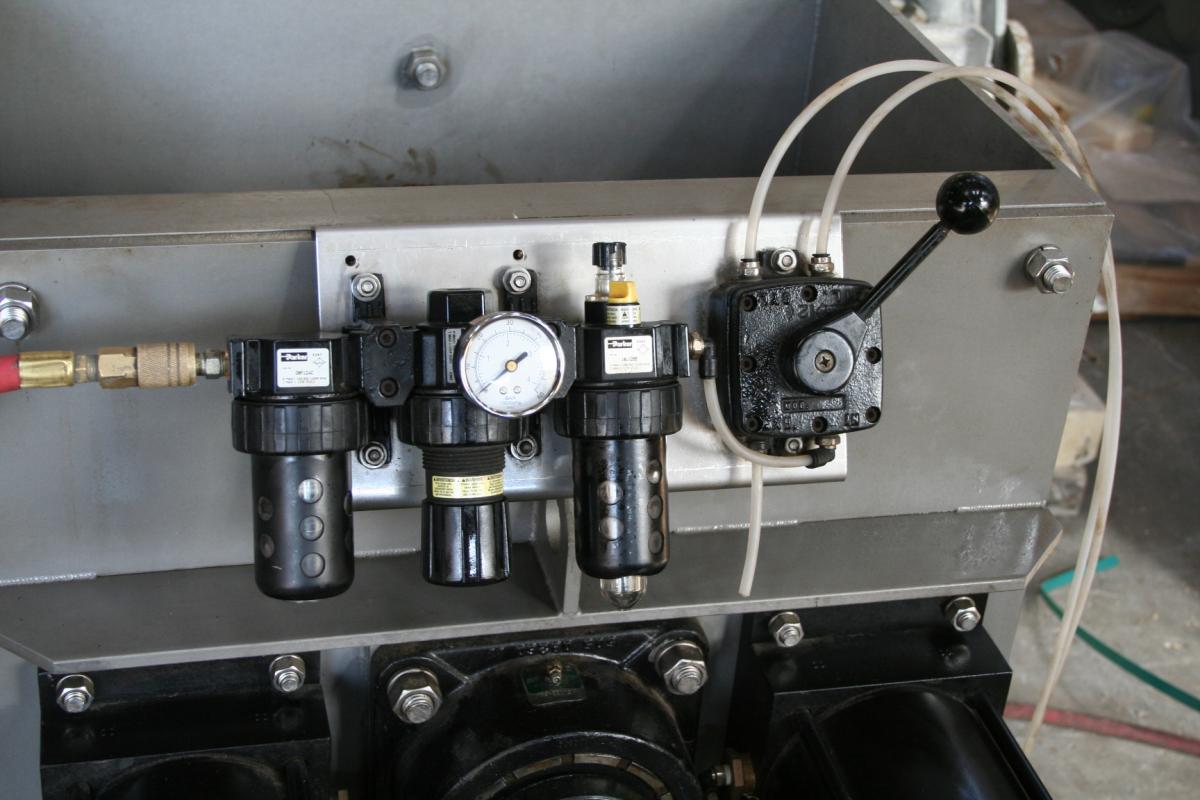
FRL SET WITH 4-WAY CONE POSITIONING VALVE
DISCHARGE CONE
The principal adjustment of the press is made with the dual discharge cone assembly. This component at the cake discharge end of the press acts as a door or stopper plug to restrict material from leaving the press. The more pressure exerted by the discharge cone, the drier the cake material will be leaving the press. Also, the motor amps can be expected to increase with added pressure, and throughput may decrease.
The discharge cone is moved in (actuated) by the air cylinders. Typical air cylinder pressures to actuate the discharge cone are in the range of 30 to 60 psi. Some materials will press only in a low range, say 10 to 20 psi. Other materials may press best with a pressure of 60 to 100 psi. Air consumption is minimal in all models, 1 to 2 cfm.
During initial, first-time, start up presses are generally started up with the discharge cone in the withdrawn position. This will avoid an unnecessary jam.
Note that with many materials it is necessary to start the press with the discharge cone in the closed position at low air pressure. Thin or soupy materials, like pumped manure or clarifier underflow, can tend to purge right through the press if the press is operated with the discharge cone open (in the withdrawn/”out” position).
However, with materials that are dry to begin with, such as sawdust or plastic wash tank sludge, it becomes more important to start with the discharge cone in the open position. This is because these materials may tend to jam or overload the press. Similarly, high freeness materials, from which the water falls away freely, will have a tendency to jam in a press. Be sure to start the press with the cone open, and gradually close it with low air pressure, when running such materials for the first time.
Once you are through the initial start up, it will be unlikely that your press should have the cone opened before starting. Most operators rarely open or shut the cone once it is set.
As the pressure on the discharge cone is increased, not only will the cake become drier, but the flow through the press may also be reduced. With very slippery or slimy feed material it may be possible to apply enough discharge cone pressure to stop the flow altogether.
High discharge cone pressures can result in increased quantities of suspended solids in the press liquor.
Care must be taken if a press is to be left running at a very low pressure like 10 psi. If some fiber enters between the cone bushings and the screw shaft, it will take more than that much air pressure to close a cone which has been pushed open by a heavy flow of cake. The result will be either high moisture content in the cake or, worse, purging.
With some feed materials, the press can be operated with the discharge cone in the withdrawn position. The screws alone may do enough compressing and dewatering to produce a cake at the discharge.
It is acceptable to open the discharge cone, in most cases, during normal operating conditions. This allows inspection, while in operation, of the discharge end of the screws and screens. This will give the operator a chance to observe operation with minimum dewatering and maximum throughput. It is also a good technique for purging bad material, i.e. either jammed or spoiled material, from the press. (Do not try this trick if you are pressing hot or chemically aggressive materials.)
Where very low air pressure is required for proper operation, it may be practical to put the cone positioning valve in the neutral position, half way between open and closed. A press can not be left permanently in this condition: keep in mind that a slug of cake will push the cone open, and it will not re-close on its own afterwards.
An unusual technique is to set the air pressure so that the cone normally stays completely shut. A timer is used to periodically open the cone. The closed period is determined by the amount to time required for press cake to accumulate in the press. This type of operation is used with slippery or slimy press cake that cannot be dewatered to sufficient firmness to force the cone to open. The duration of the “cone open” period is long enough to dump most of the press cake that has been formed. Cone Timer panels are available from Vincent at a minimal cost.
Once through start-up, the cone is almost always left in the closed position at whatever air pressure had been found to be effective. A plug of cake will be left around the cone whenever the press is turned off; this will clear on its own accord on restarting the press.
There are a few applications where the air cylinders are removed and replaced with a jacking bolt. This is used if the cone pushes completely closed even with the lowest air pressure. It results in operating the press with a fixed discharge annulus. Alternatively, air cylinders with linear actuators are available.
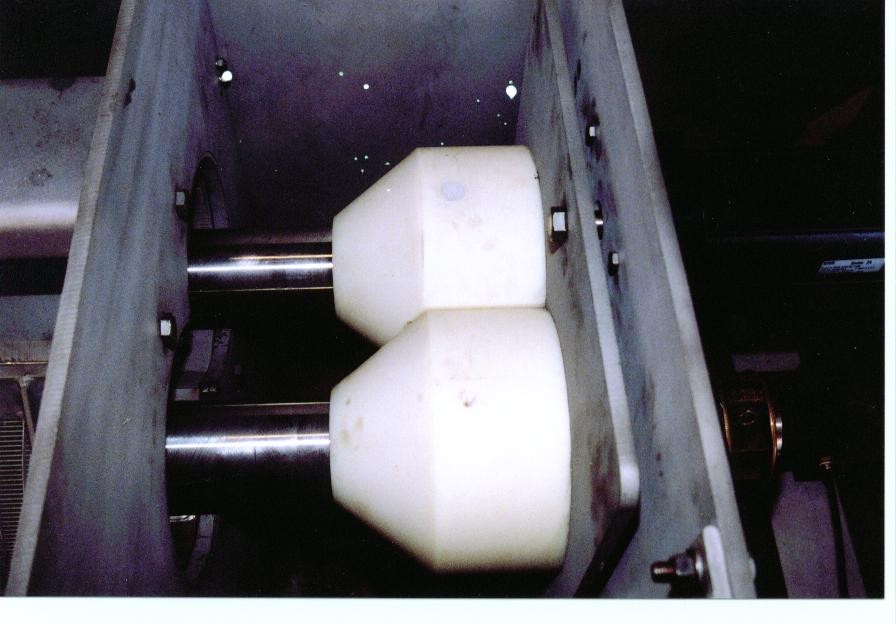 DISCHARGE CONE
INTERMITTENT OPERATION
In the case of intermittent operation, it is recommended that the control panel for the feed pump or conveyor which feeds the press should have a timer. This timer should be set to have the press run for two minutes after the feed pump (or conveyor) shuts off. This will partially clear the press so that it will not trip out on overload when it is re-started. (This applies in high torque applications or in installations where the material in the press dries out or freezes.)
Minimize the time that the screw press is run with no material being fed into it. The last material admitted to the press will dry to powder, and it can cause severe accelerated abrasive wear.
Initially the press will likely be run empty in order to check rotation. Even though some rubbing may be heard, negligible wear will occur so long as this period is kept to a minimum. Also, since the screw is supported to some extent by the material inside the press, running dry may allow the screw to rub the screen. (See the previous section, INVERTER VFD & PLC CONTROL.)
DOUBLE PRESSING
Some processes benefit from what is called double pressing. This means that the cake coming from the press is run through the press a second time (or through a second press). If little moisture is removed in the second (double) pressing, then it is known that the liquid removed in the first pressing is all of the free liquid that there is to be pressed out.
Sometimes water is added to the cake in between the first pressing and second pressing. This is done to enhance the recovery of dissolved sugars in the original press cake.
Molasses can be added to press cake between the first and second pressing. This is used to infuse dissolved sugar into the cake, increasing the solids content of the final press cake.
Capital-effective double pressing can be achieved by using an inexpensive Soft Squeeze Series KP screw press for the first pressing, following with a tighter-pressing Series TSP in the second position.
MOISTURE CONTENT
A screw press separates free water. This will leave organic water in the press cake. The organic water is either bound to, or part of, the animal or vegetable molecules. Mechanical pressure alone will not remove organic water; it takes heat or chemistry. Frictional heat from the press can remove organic water, but this obviously should be avoided. For chemistry, see the HYDRATED LIME, GYPSUM AND ALUM section. For heat, see the FLUID INJECTION section.
To determine the moisture content of a material (feed to the press, press cake, or press liquor), a sample should be weighed and dried overnight at a temperature slightly less than 100o C. (If sugars are present, use less than 70º C to prevent caramelizing.) The sample should weigh six or more times the tare weight of the sample tray or cup.
The moisture content of press cake varies considerably. Tomato press cake will be 90% moisture. Orange peel will be 80%, unless it is reacted with hydrated lime, in which case it will go down to 72% moisture; add molasses and it will go to 65%. Dairy and hog manure will come out at 70% moisture, unless there is sand or sawdust in the sample, which will reduce the moisture content. Cellulose fiber from a paper mill (knots, screen rejects, primary clarifier underflow) will come out about 50%. However, if secondary (biological) sludge is added, then the moisture content of the cake will go up considerably. With high ash content in paper mill samples, moisture may go down to 40%. Moisture contents of only 25% can be achieved pressing things like sand, eggshell, glass, and plastic chips.
The heat from steam injection can change the chemistry of the material being pressed so that cake with lower moisture content is produced. This blanching or parboiling effect works with fish and orange peel, for example.
A quick approximation of what to expect from a screw press is to squeeze as much water out with your fist, and figure that the press will do a little bit better. A better way is to twist a ball of the material in a cotton cloth.
COMPRESSION
A screw press achieves compression using several methods: (1) The discharge cone of the press causes back-pressure on the material being dewatered. The higher the cone pressure, the greater the liquid removal. (2) The pitch of the flights of the screw tightens as the material is conveyed through the press. This forces liquid to go through the screen. (3) The diameter of the shaft of the screw may be increased progressively, forcing material outward, against the screen. This is a tapered shaft design.
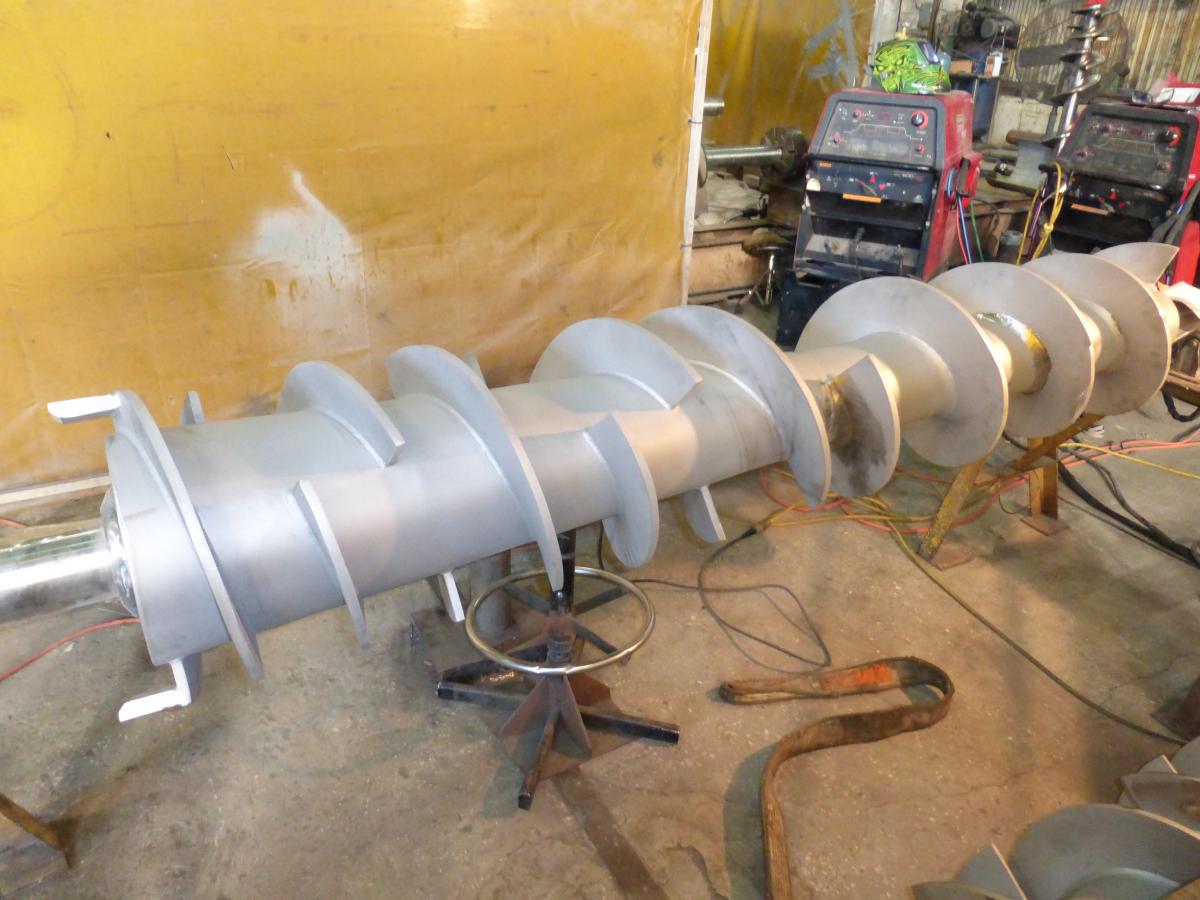
SCREW WITH TAPERED SHAFT
Force-feeding (supercharging) the press and applying a vacuum to the outside of the screen are two additional methods which may achieve compression. These two are used infrequently because the performance results are uncertain.
PRESS SPEED (RPM)
In general, the slower the screw speed, the greater the dewatering. Longer residence time in the screened area results from lower screw speed, which allows time for more thorough dewatering. Unfortunately, it also goes with reduced throughput capacity.
Screw press speed (rpm) can be changed by using a Variable Frequency Drive (VFD). Alternatively, the drive motor can be switched to a different pole motor (900, 1200, or 3600 versus the standard 1800 rpm). Most modern motors are good for permanent 120 Hertz operation; they are always good for a test at this high speed.
Higher speed can result in premature gearbox failure. Switching to synthetic oil, replacing the normal mineral oil, is recommended. Consult the factory for assistance.
The smaller Nord gearboxes are all rated for 4,000 rpm input, which makes it easy to switch to a 3000/3600 rpm motor. It is best to switch to synthetic lubricant if this change is permanent. With other gearboxes, the higher speed can result in premature gearbox failure. Consult the factory for assistance.
It has become normal for a VFD to be used with Vincent presses.
Low screw speeds are used for cooker crumb, potato peel, many sludges, and low freeness materials in general.
CAPACITY MEASUREMENT
The best way to measure capacity of a press is to collect timed samples of press cake and of press liquor. This should be done during a period of sustained, stable operation, rather than by timing a batch through the press.
Press cake is generally captured in a tarpaulin, and press liquor in a 5-gallon pail or 55-gallon drum. When the drain is at floor level, a 3-mil plastic bag can be used to catch press liquor. If the press liquor goes to a pit or tank, the change in depth can be timed.
Sometimes it is possible to collect only one flow, either press cake or press liquor. In these cases it is possible to estimate the press throughput if the solids content of the inbound material and press cake are measured. It is assumed that there are zero suspended solids in the press liquor, although this is never really the case.
A/B/C/D-PLATES
There are four vertical plates making up the frame of the press. These are called out in the Nomenclature drawing at the end of this manual.
Starting from the drive end of the press, the first one is the A-plate. This A-plate forms the wall of the inlet hopper closest to the gearbox. The shaft seal plates are bolted to the A-plate.
The next plate is the B-plate. It forms the downstream wall of the inlet hopper. The screen starts at the B-plate.
The third plate, the C-plate, supports the discharge end of the screens. The discharge cone touches this plate when the cone is in the closed position.
There is a fourth plate, called the D-plate, on which air cylinders and thrust bearing are mounted.
SCREW LIFE
If a press loses its previous throughput capacity, or if cake moisture content increases, it can be a sign of a worn screw.
A screw can last anywhere from six months to twenty years. It depends on the material being pressed and how hard it is being pressed.
Premature screw failure can arise from several causes. The two main ones are:
(a) If a press is allowed to run continuously even when no material is being fed into it, the screw can wear out in one or two months. The same can happen if a very low flow is consistently fed into the press.
(b) If abrasive material is dewatered with high cone air pressure, rapid wear will occur. This condition is avoided if a few drops of water can always be squeezed from a fistful of press cake.
Two effective ways to extend screw life are:
(a) Various grades of hardsurfacing rod can be used to protect the flights of a screw. The best hardsurfacing will have Tungsten Carbide impregnated in it.
(b) Using a VFD or lower speed motor to reduce the screw rpm will extend screw life.
If a worn screw is suspected, the thing to do is to shut down the press, open the cone, and dig out the cake until the tips of the last two flights can be seen or felt. Check how badly the tips are worn. If the there is 3/8″ between the tips and the screen, serious wear is evident. It is also an indication that the sharp edges of the flights throughout the press may have worn, becoming rounded. This can cause the flights to act like a putty knife, plastering solids against the screen, preventing water from coming through.
Worn screws are either restored locally or returned to Vincent for rebuilding. The cost of a screw rebuild is around two thirds the cost of a new screw.
SCREW CONFIGURATION
All Vincent screw presses use the interrupted flight screw design. The interruptions leave room for stationary resistor teeth, mounted rigid to the frame of the machine, to reach almost to the shaft of the screw. This d