
Shredders Can Improve Screw Press Performance
Frequently a screw press performs better if material is shredded before being admitted into the press. For that purpose Vincent Corporation offers a line of shredders. These are sized to bolt directly onto the inlet of Vincent screw presses.
The Vincent shredder is a horizontal machine with a 180 degree discharge area on the underside. It is ideally suited to bulky materials, such as citrus peel, whole fruit, and produce waste.
Shredder Operation
The blades rotate about a horizontal shaft. They are fixed in place rather than designed to swivel, and are made of hardened 410 stainless steel and keyed to the rotor.
Modern Vincent shredders position the blades 180 degrees apart. This configuration increases capacity by optimizing the interval between blades passing the inlet, allowing material to fall deeper into the shredder before being struck by the next blade.
When a slicing action is preferred over mashing, the cutting edges can be sharpened to a 45-degree angle.
Demonstration of Angled Shredder and Vincent Comb Shredder processing Seaweed.
Quick Tip: Extend the life of shredder through reversing the rotation
A key advantage is that the direction of rotation can be reversed to obtain double the life of the rotor. This is done by simply reversing two of the power lead wires to the motor.
The Vincent Shredder is well suited for wet and dry materials. Optimum performance is achieved with materials containing either more than 80% moisture or less than 20%.
Discharge Options:
The material being shredded is forced through the discharge of the machine. The material can be thrown through a screen, a comb, or a free opening, depending on the machine configuration.
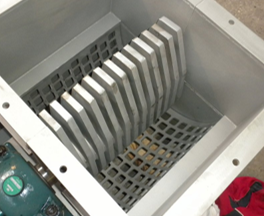
Screen Discharge
The VS models have a screen mounted in the discharge.
A variety of screen sizes are available for those models which use screens. Typically these are in the range of 3/4″ to 2″, generally in the form of square-round holes. Screens are made of either 304 stainless or carbon steel.
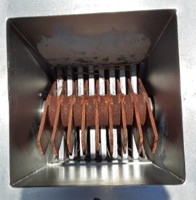
Comb Discharge
The VCS models have a comb (or grille) in the discharge. A tooth from the comb fits between each pair of rotor blades. This creates a scissor action, which is ideal for onion parchment.
The VCS models are very susceptible to serious damage if rigid tramp material, such as tools or rocks, fall into shredder. Also they are susceptible to jamming on start-up if material is left in the machine. For this reason they are commonly used without the comb in service.
Alternatively, the shredder can be operated with neither a screen nor comb in the discharge. This provides a coarse grind.
Loading Options:
The shredders have a square inlet. Large shredders are typically fed with a screw conveyor. Since the shredder throws material upward as well as downward, it is important to have a cover over the screw conveyor trough at the shredder.
8″ and 12″ shredders are frequently used for laboratory and pilot operations. Where these machines are batch fed, a dogleg inlet chute should be used to prevent throw-back material from making a mess or causing injury.
Shredder Housing Options:
Shredder housings are easily un-bolted to ease the changing of screens and rotors. Washing and inspection are also facilitated.
Shredder housings can be either split or hinged, so as to allow ease of clearing jams, changing rotors, or replacing screens. In operation the upper part of the housing fits folded around the inlet chute, or it is bolted to the bottom flange of an inlet chute. A discharge transition piece can be provided to fit the screw press being used.
Size Considerations:
On the larger 18″ models we use one expansion pillow block bearing and one non-expansion pillow block bearing to support the rotor. The non-expansion bearing goes in the inboard position, closest to the coupling. The rotor does not expand from heat, but it can move from shock and distortion. So we lock one end of the rotor and let the other float.
The 18″ shredders use Dodge ParaFlex couplings between the motor and rotor. This keeps shock from the rotor from being transmitted to the motor. The ParaFlex is like the tire of a small car. One rim is clamped to the rotor shaft and the other rim is clamped to the motor shaft. These are rather expensive, but they are the best coupling for the application.
Power Source:
Vincent shredders are powered by premium efficiency electric motors. The 18″ diameter shredders with direct coupled motors run at 1800 or 1500 rpm. The smaller 12″ and 8″ shredders run at 3600 or 3000 rpm. We have also built a lot of shredders with belt drives between the motor and the rotor. These are direct coupled to the rotor shaft. Some models, with two bearings, use Dodge Para-Flex couplings. Other models, with one outboard bearing, use rigid couplings.
Materials Used:
Vincent shredders use 304 stainless for parts that are in contact with the material being shredded. Base frames are made of carbon steel.
| MODEL | ROTOR DIAMETER |
MAXIMUM CAPACITY lb/hr |
INLET DIMENSIONS in InchesWxD |
OUTLET DIMENSIONS in InchesWxD |
WEIGHT | DIMENSIONs | MOTOR HP |
| VS-8 & VCS-8 | 8″ | 4,000 | 8-1/2 x 8 | 8-1/2 x 8-1/2 | 300# | 12″ x 36″ x 18″ | 5-15 |
| VS-12 & VCS-12 | 12″ | 10,000 | 13 x 12 | 13-3/4 x 13 | 800# | 16″ x 48″ x 21 3/4″ | 10-20 |
| VS-18 & VCS-18 | 18″ | 40,000 | 18 x 18 | 22″ x 18″ | 1600# | 24” x 60″ x 31 3/4″ | 30-60 |
Dimensions and weights are only approximate. Throughput capacities vary considerably. They are subject to on site testing. These figures are based on citrus waste.
Improve Screw Press Performance with a Shredder
Properly preparing material before it enters the screw press can improve feeding and help maximize press performance. Vincent Corporation can help determine whether a shredder is right for your application.